
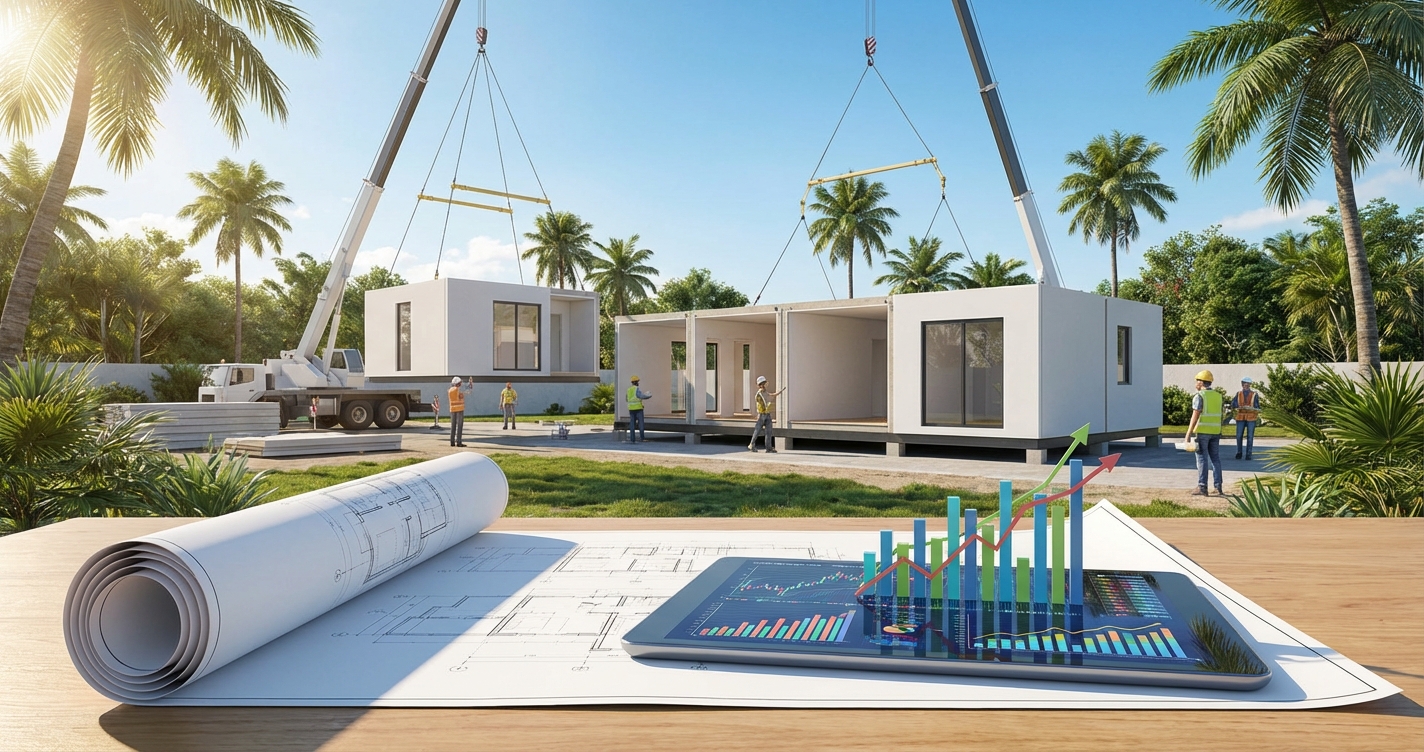
The current real estate landscape presents a persistent challenge for investors: skyrocketing construction costs, protracted timelines, labor shortages, and an urgent, unmet demand for affordable, high-quality housing. Traditional stick-built construction methods are increasingly failing to deliver the efficiency, speed, and cost-control necessary for maximizing investor returns.
Smart investors are shifting their focus to innovative solutions that mitigate risk while capitalizing on market needs. This comprehensive guide provides a definitive roadmap for real estate investors navigating construction and development, drawing on insights from industry experts with decades of experience.
The Imperative of Construction Risk Mitigation
For any real estate investor, construction is arguably the phase of highest risk—where budgets are overrun, timelines are stretched, and profitability is destroyed. A proactive, forensic approach to due diligence is non-negotiable for success.
Forensic Due Diligence on Contractors
The success of a build often hinges on the quality and reliability of your contractor. Investors must move beyond surface-level reviews and apply forensic scrutiny:
- Financial Stability: A contractor's past financial instability—manifesting as unpaid suppliers or bankruptcies—is a direct risk to your project. Demand detailed financial transparency and verify their credit history.
- Operational Capacity: Evaluate the contractor's current workload. An overloaded contractor is a recipe for delays. Focus on their historical performance against stated timelines and budgets.
- Contractual Documentation: The construction contract must clearly define scope of work, payment schedules, penalty clauses for delays (liquidated damages), and a transparent draw schedule.
Working with established construction partners who have proven track records eliminates much of this risk from the start.
The Contract: Your Blueprint for Accountability
The contract is more than a legal document—it's your mechanism for enforcing accountability:
- Clarity on Specifications: Ambiguity in the scope of work is the primary source of disputes and cost overruns. Define every material, finish, and fixture with specificity.
- Draw Schedule Power: Tie payments directly to clearly defined, verifiable milestones. Never pay for work that has not been completed and successfully inspected.
- Performance Benchmarks: Establish clear, measurable timelines for major milestones. Always budget a 10-15% contingency for unforeseen issues.
Modular Construction: A Strategic Differentiator
The perception of modular housing as "mobile homes" is outdated and financially detrimental to investors who ignore this advanced construction method.Modern modular construction represents a powerful strategic advantage for real estate investors.
Deconstructing the Myth: Modular is Not Manufactured
Modular homes are fundamentally different from manufactured homes. They're constructed to the same (or often superior) state and local building codes as traditional stick-built homes:
- Factory-Controlled Environment: Construction occurs in a climate-controlled factory, eliminating weather-related delays and damage.
- Superior Structural Integrity: Units are engineered for transport, resulting in a structurally stronger, more robust final product.
- Customization Options: Modern modular units offer high-end finishes, 9'4" ceilings, two-car garages, and customizable floor plans.
The Investor's Advantage: Cost, Speed, and Certainty
For the investment model, modular construction directly addresses the key pain points of traditional building:
- 10-20% Cost Savings: Reduced waste, bulk purchasing, and faster labor drive significant savings compared to equivalent stick-built projects.
- Accelerated Timelines: The home's construction completes in a factory in roughly 30 days while site work happens concurrently. Total timeline: 2-4 months versus 6-8 months traditional.
- Reduced Carrying Costs: Shaving months off build time drastically reduces bridge loan interest, property taxes, insurance, and other holding costs.
Learn more about maximizing ROI with modular construction.
The Duplex Strategy: A Core Pillar of Affordable Housing Investing
The convergence of high property costs and high interest rates has made multi-family construction—specifically duplexes—a strategic imperative for investors focused on both high returns and addressing housing scarcity.
Unlocking Multi-Family Efficiency
A duplex offers a compelling combination of cost-effectiveness and versatile exit strategies:
- Reduced Cost Basis: Two high-quality units sharing a roof, foundation, and fire-rated marriage wall significantly reduces per-unit construction cost.
- Build-to-Hold: Hold the property as a two-unit rental, maximizing long-term cash flow and portfolio value.
- Separate Sale: In many markets, duplex units can be legally separated and sold individually as attached townhomes.
- House Hacking: An end-user can purchase one side, live in it, and use rental income from the second unit to reduce housing costs.
Favorable Zoning Trends
In response to the affordable housing crisis, many municipal governments are revising zoning codes to allow two-unit construction on lots previously zoned strictly single-family. Investors should perform meticulous due diligence on local zoning requirements to identify opportunities to maximize profitability through density.
The Turnkey Investment Ecosystem
Attempting to execute complex construction projects in a vacuum is an antiquated approach. Modern investors scale their portfolios by leveraging a powerfulturnkey ecosystem.
The Power of a Cohesive, Vetted Team
The turnkey model eliminates friction and risk associated with assembling an unproven team for every transaction:
- Acquisitions/Sourcing: Access to a dedicated sourcing specialist who consistently provides discounted land or deals.
- Vetted Construction: Working with a builder who understands modular installation ensures guaranteed cost and timeline adherence.
- Specialized Financing: A private or institutional lender who understands these projects is non-negotiable for smooth capital deployment.
Financial Advantages of the Ecosystem
- Volume Discounting: Aggregating projects allows builders to negotiate significant bulk discounts on materials.
- Certainty of Closing: A unified team provides certainty of execution—the acquisitions team knows the builder can perform, and the builder knows the lender will fund.
- Predictability and Scalability: This transforms a high-risk, ad-hoc construction process into a predictable, repeatable model.
Strategic Land Acquisition: The Ultimate Due Diligence
The success of any development project begins with the land. Poor site analysis can negate all the advantages of modular speed and cost savings.
- Utility & Infrastructure: Confirm the capacity and cost of connecting to all essential utilities before closing. High-cost hookups can destroy profitability.
- Zoning and Restrictions: Verify local zoning ordinances, CC&Rs, and environmental overlays that could restrict what can be built.
- Topography and Geotechnical: Understand costs associated with grading, soil conditions, and flood zones. Unanticipated site work is often the largest cost overrun.
Key Takeaway: Smart real estate investors mitigate construction risk through forensic due diligence, strategic use of modular construction, and leveraging turnkey ecosystems. The combination of 10-20% cost savings, 50% faster timelines, and reduced carrying costs makes this approach increasingly essential for maximizing returns in today's competitive market.
Ready to learn more? Explore our 7-step process for building modular homes in Florida, or schedule a consultation to discuss your investment goals.